A guide to fiber, fabric, and everyday care
Coyuchi Sheets: How Fiber, Weave, and Care Shape Comfort
A sheet is more than a smooth surface beneath a sleeper. It is a small textile landscape: fibers twist into yarn, yarns cross into cloth, and washing gradually changes the fabric’s hand. Understanding those details can help you assess how sheets may feel, manage moisture, and fit into the routines of a real household.
Start with the fiber, not the softness claim
When comparing Coyuchi sheets—or any bedding—begin with the fiber listed on the label. “Soft” is a useful description, but it does not tell the whole story. Two sheets can feel pleasant in a showroom or on first use and behave differently after repeated laundering. Fiber content offers a more practical starting point: it helps explain a fabric’s texture, weight, moisture response, and likely care needs.
Linen begins with flax. The plant’s stalks provide fibers that are spun into yarn and woven into fabric. The result is often recognized by its visible texture and gently irregular surface. Linen can feel crisp or substantial at first, depending on its construction and finish, and it commonly becomes more supple as it is used and washed. That gradual change is part of the material’s character, rather than evidence that the cloth has simply been made to feel soft at the outset.
Cotton and linen are both plant-based fibers, but they are not interchangeable in feel. Cotton sheets often offer a familiar, smooth surface, while linen tends to have more pronounced texture and a relaxed drape. Neither is automatically the better choice. The right one depends on what feels comfortable against your skin, how warm your room becomes, how often you wash bedding, and whether you prefer a pressed appearance or an easy, rumpled finish.
Fiber content also matters when the product is described as organic. That word should be read alongside the product’s certification details and sourcing information, not treated as a complete account of every part of manufacturing. For example, a product description may identify organic flax, specify where it was grown and woven, and name a certification. Those details give readers more to assess than a broad sustainability slogan alone.
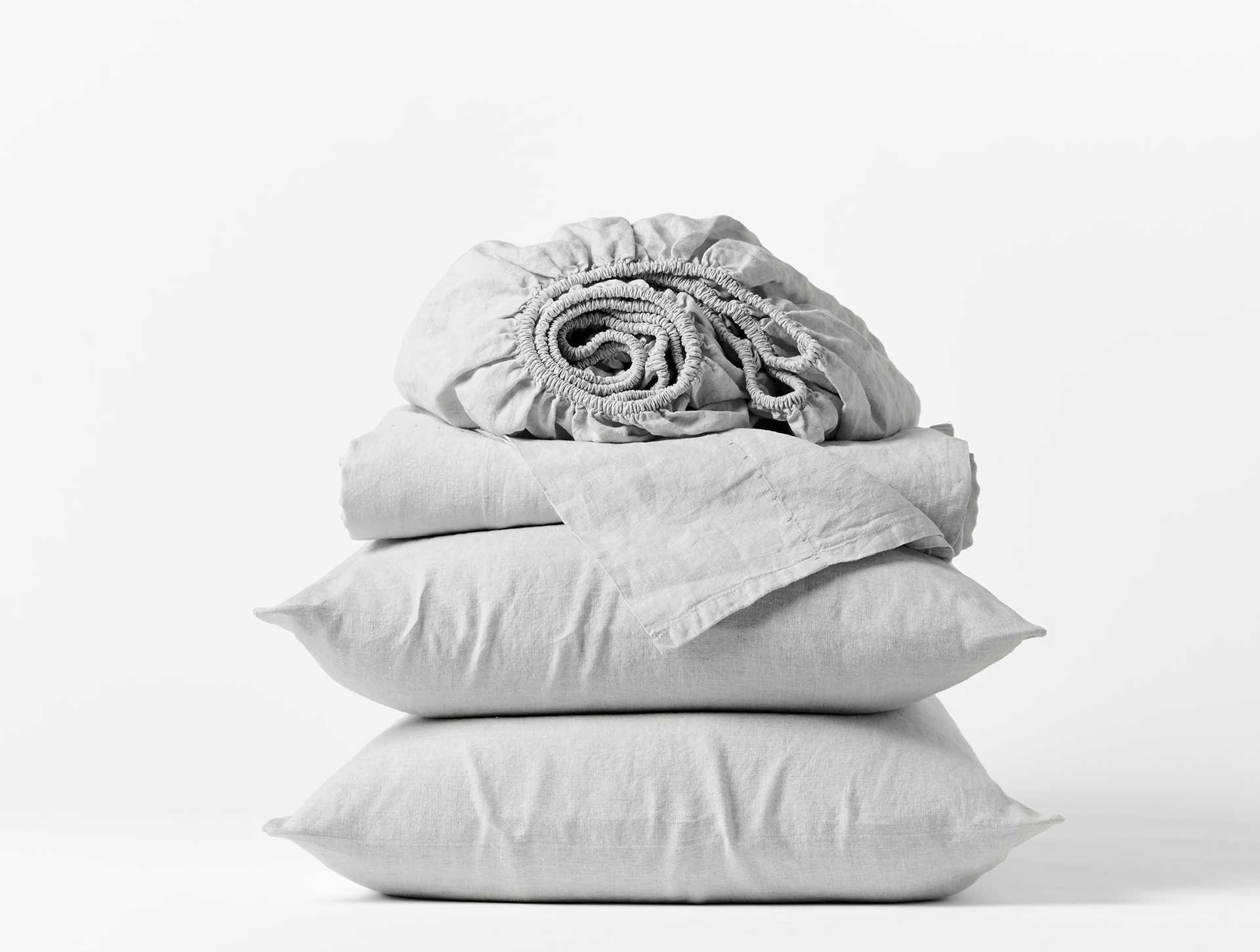
One example in the available range is the Coyuchi Organic Relaxed Linen Sheet Set. Its listed material is 100% organic flax; the description identifies French-grown flax woven into linen in Portugal and notes GOTS certification. These are concrete label details to consider alongside the sheet’s feel, fit, and care instructions. They do not by themselves tell every reader how the fabric will feel at home, since comfort is personal and also depends on construction and finishing.
What “breathable” can—and cannot—tell you
Breathability is one of the most common reasons people explore linen sheets. In everyday terms, it describes how readily air and moisture can move through a fabric. That movement can contribute to a less clammy feeling for some sleepers, particularly when a bedroom is warm. Linen’s structure and the way its yarns are woven can help create a fabric that feels airy, but no material can guarantee a particular sleep temperature. Room conditions, mattress construction, blankets, sleepwear, and individual comfort all play a part.
Moisture management is related to breathability, but the terms are not identical. A fabric may take up some moisture and then release it as conditions change. Whether that feels comfortable depends on the amount of moisture, airflow, and how quickly the textile dries. This is why claims about cooling should be understood as descriptions of fabric characteristics rather than a promise that every person will sleep cooler.
Linen is also often described as suitable across seasons. That does not mean it acts like a thermostat. Instead, a breathable textile may be useful in different conditions when paired with appropriate layers. A light cover in summer and a warmer duvet in winter can change the overall sleep environment without changing the sheets. The sensation of a sheet is produced by the whole bed, not by fiber alone.
Consider your own sleep environment before interpreting a product description. Do you tend to feel warm at night? Is the room humid, or does it have steady ventilation? Do you sleep under a heavy duvet? Those questions may be more useful than a general promise of year-round comfort. If possible, pay attention to how a fabric feels after washing as well as when it is new, because finishing treatments and use can affect the first impression.
Weave, weight, and the hand of the cloth
Fiber is the raw material; weave is one part of the architecture that turns yarn into a sheet. In a woven fabric, lengthwise and crosswise yarns interlace in a repeated pattern. The pattern, yarn characteristics, and density of construction all influence the cloth’s surface and drape. A looser construction may feel more open and relaxed, while a denser one can feel more compact. Labels do not always explain every technical detail, so descriptions of weight, finish, and fabric origin can help fill in the picture.
Thread count is often treated as a shortcut for quality, particularly in cotton bedding. For linen, it is generally more useful to look at the material itself and the full construction story. A single number cannot describe yarn quality, finishing, fabric weight, or how a sheet will respond to laundering. When specifications are available, compare them with the product’s stated fiber and care guidance instead of assuming that a higher count must mean greater comfort.
Weight can help distinguish one linen from another, though it is not a verdict on quality either. A heavier cloth may feel more substantial in the hand and drape differently across the bed. A lighter one may feel less weighty. The right balance is a matter of preference and use. Someone seeking a softly textured, lived-in surface may welcome a relaxed linen finish, while a sleeper who prefers a smoother, more uniform feel may choose another construction or fiber.
Finishing is another important part of the story. Washing, garment dyeing, or other treatments can influence the initial softness, surface appearance, and degree of variation in color. A prewashed or relaxed finish can make linen feel less stiff from the beginning, while the fabric may continue to soften with use. A finish is not a substitute for checking the underlying fiber, however. Read both the material composition and the finishing notes to understand what you are considering.
Small construction details affect use as well as appearance. The Organic Relaxed Linen Sheet Set description specifies a full-elastic fitted sheet with a 15-inch pocket and pick stitching at the cuffs. Pocket depth matters because a fitted sheet must accommodate the mattress and any topper without pulling loose. Before choosing a set, measure the mattress depth, including any topper, and compare it with the sheet’s stated dimensions. For unusually deep or adjustable mattresses, sizing can make the difference between a secure fit and a sheet that shifts during the night.
Read the label as a small map
A useful sheet description answers a group of practical questions. What is the fiber content? Is the fabric blended or made from one fiber? Where was the fiber grown, and where was the cloth woven or finished? Are certifications named? What pieces are included in the set? How deep is the fitted sheet? These details let you compare products without depending solely on adjectives such as “luxurious,” “cool,” or “soft.”
For a set, check the contents carefully. “Sheet set” can mean different combinations depending on the size and maker. A set may include a fitted sheet, a flat sheet, and pillowcases, but the number or style of pillowcases can vary. If you use two pillows, have nonstandard pillow sizes, or do not use a flat sheet, confirm exactly what is included before making a decision.
Certifications can help clarify particular standards, but readers should still understand what the named certification applies to and verify current details from the product label or certifying organization when that distinction matters. A certification is one piece of evidence about standards; it does not automatically answer questions about softness, durability in a particular household, or the environmental effects of every stage of a product’s life.
Origin statements also need careful reading. The place where flax is grown may differ from the place where it is spun or woven, and the finished item may involve additional stages. A clear description separates those steps rather than implying that a single country tells the entire story. This kind of detail is valuable not only for conscientious sourcing, but for anyone who wants a more complete understanding of how a textile came to be.
Color and finish deserve attention because they can influence maintenance. Dark, saturated, or mixed-color linens may need to be washed with like colors, especially at first. Product instructions take priority over general advice: a specific fabric treatment or construction may call for a different routine from another linen sheet. Keep the care label accessible, since the safest method is the one intended for that particular textile.
Care is part of the fabric’s life
Sheets encounter skin oils, perspiration, household dust, detergent, water, and the movement of a washing machine. Each wash is a small mechanical event: cloth folds, rubs, twists, and dries. A measured care routine can reduce unnecessary strain and help linen maintain a comfortable hand over time. The goal is not to preserve a sheet in an untouched state, but to clean it effectively without exposing it to more heat or agitation than its instructions recommend.
For the Organic Relaxed Linen Sheet Set, the listed instructions call for machine washing cold on a gentle cycle with like colors, then tumble drying on low and removing promptly. Warm ironing is optional. Following those directions is a sensible baseline for that product; other linen sheets may specify a different water temperature, drying method, or ironing approach. Do not assume that all linen is cared for identically just because the fiber name is the same.
Before washing, check that the machine is not overloaded. Fabric needs room to move through the wash and rinse, and a crowded drum can leave linens twisted together or inadequately rinsed. Wash compatible colors together and use detergent in a measured amount, following the detergent’s directions and the garment-care label. More soap is not necessarily better; excess residue may remain in fabric or require extra rinsing.
Low heat and prompt removal from the dryer can help limit over-drying and heavy creasing. Linen naturally develops folds, so ironing is a preference rather than a requirement unless the care label says otherwise. If you do iron, the product guidance may recommend using a warm iron or working while the cloth is slightly damp. Always check the specific instructions before applying heat, especially when sheets have decorative details or a special finish.
Air-drying is another option when conditions allow and the care directions permit it. Allowing air to circulate around a sheet can reduce reliance on a dryer, while a well-supported line or rack helps prevent the fabric from dragging on the ground. Avoid leaving damp linens bundled together for long periods, since trapped moisture can lead to musty odors. Once fully dry, fold or place them on the bed so they are ready for use.
Stains are best addressed promptly, but treatment should suit the stain and fabric. Blot rather than scrub aggressively, and test any stain product on an inconspicuous area when the care label allows. Chlorine bleach is not suitable for every linen; some product instructions explicitly prohibit it. Avoid improvised combinations of cleaning agents. When in doubt, follow the manufacturer’s care information or seek professional textile-cleaning guidance for a valuable or delicate item.
Make the choice fit your sleep habits
There is no universal “best” sheet. A comfortable choice is the one that fits your body, room, mattress, and maintenance habits. If texture is important, think about whether you enjoy linen’s visible weave and relaxed surface. If you prefer a smooth, cool-to-the-touch finish, compare samples or product descriptions carefully and consider other fibers as well. If regular ironing feels like an unwelcome task, look for care instructions and finishes that suit a more casual appearance.
Climate matters, but personal sensation matters too. People in the same room may prefer different bedding because they sleep differently, use different blankets, or respond differently to touch and temperature. Rather than relying on a broad seasonal claim, assess your own conditions: bedroom temperature, humidity, ventilation, mattress protector, duvet weight, and sleepwear. Changing one layer at a time can help you understand what is actually affecting comfort.
Household routines should be part of the decision. Consider how frequently you wash sheets, whether you air-dry or use a tumble dryer, and whether you need a fabric that can withstand a busy laundry schedule. Check the stated care temperature and dryer settings against your available equipment. A textile that suits your preferences but requires a routine you cannot maintain may be less practical than a different option with care directions that fit daily life.
Durability is best considered over time rather than inferred from a single marketing phrase. Strong fibers, sound construction, correct sizing, and considerate laundering all contribute to a sheet’s useful life. A relaxed fabric may soften with repeated washing, but changes in texture are not a substitute for inspecting seams, elastic, and fabric condition. Rotate sets where possible, avoid unnecessary high heat, and repair small seam problems early if repair is practical.
Also think about how bedding works as a system. A fitted sheet must match the mattress; pillowcases need to fit the pillows; and a duvet cover or blanket can change the perceived warmth and weight of the bed. Coordinated color is an aesthetic choice, but compatibility and care requirements are functional ones. If different pieces require different wash routines, decide whether that extra sorting is manageable.
A practical checklist before choosing
Before settling on Coyuchi sheets or another set, use the product page and physical label as a checklist rather than a sales pitch. The following questions can make comparisons clearer:
- What is the exact fiber content? Look for named materials and percentages, and note whether the fabric is a blend.
- What is known about origin and construction? Distinguish where the fiber was grown from where it was woven or finished.
- How is the fabric finished? Washed or relaxed finishes may affect the first feel and appearance.
- What does the set contain? Confirm flat sheet, fitted sheet, pillowcase count, and any size-specific variations.
- Will the fitted sheet fit? Compare mattress depth, topper height, and the stated pocket depth.
- Do the care instructions fit your routine? Check washing temperature, cycle, drying method, ironing guidance, and any bleach restrictions.
- Which qualities matter most to you? Prioritize texture, breathability, appearance, easy care, sourcing information, or a combination.
These questions replace vague comparison with useful observation. They also help distinguish between what a product description states and what an individual sleeper may experience. A fiber label can establish composition; a care label can guide laundering; neither can predict exactly how a sheet will feel to every person after months of use.
Comfort is a relationship between cloth and habit
On a bed, textile science is experienced at close range. A sheet meets skin, holds the shape of a mattress, and changes through the ordinary cycle of sleeping, washing, drying, and folding. Fiber explains part of its behavior. Weave and weight shape its hand and drape. Finishing influences the first impression. Care determines how the cloth travels through its daily life.
That is why the most useful way to assess Coyuchi sheets is to move beyond a single promise of softness. Read the fiber composition, examine construction and fit, and treat care directions as part of the product rather than fine print. Linen may appeal to sleepers who value natural texture, breathability, and a fabric that becomes more relaxed with use. Another material may better suit someone who prefers a smoother surface or a different laundering routine.
In the end, a good sheet is not simply the one with the most impressive description. It is the one whose material, construction, size, and care requirements make sense in the bedroom where it will be used. A closer look at those details turns bedding from a guess into an informed choice—and makes everyday comfort a little easier to understand.